TWENTY-THIRD SUNDAY IN ORDINARY TIME (2023)
Readings:
Ezekiel 33:7-9
Psalms 95:1-2, 6-9
Romans 13:8-10
Matthew 18:15-20
Imagine the burden of being responsible for the entire universe, a burden we surely feel is only experienced by God. After all, we puny and frail human beings live in a rather narrow slice of God’s creation, and we often impose limits on “our world,” which often harshly narrows the scope of those who could very well need our attention. The boundaries on “our world” can often be set for the most frivolous of reasons – socio-economic reasons, reasons having to do with racial disparity, religious or political reasons, and reasons having to do with proximity (“they live on the other side of the world”). Today’s gospel presents us with a real challenge, for Jesus is as much saying that we are responsible for all our brothers and sisters, and He even highlights a way that we should deal with them (Bishops beware, the gospel way is unlikely the way you would prefer to run things!)
Our gospel is forever enshrined, and ignored, in our Church’s Canon Law, the book meant to be used to justly govern the entire church and guide its celebration of the sacraments. At the end of the magnus opus, in the section entitled “The Procedure in the Removal or Transfer of Pastors” (Canon 1740-1752), the Law outlines [in other words], our gospel passage. There is what is often referred to as ‘fraternal correction,’ what Matthew describes in the first part of today’s gospel: “If your brother sins against you, go and tell him his fault between you and him alone.” Notice that Jesus suggested that it be a quiet thing, something between two people. In Canon Law, it also takes place quietly. After a quiet discussion with two pastors, the bishop is to “paternally persuade the pastor to resign within fifteen days.” Beyond the fifteen days the pastor is given many weeks when additional requests are made, and is allowed time to “organize his objections” to the reasons given for the Bishop’s desire to remove him, offering “proofs to the contrary.”
The reasons for citing Canon Law are surely obvious to the readers of these reflections, but it serves to highlight that the guiding principles for everything we do are to be found in the very words of Jesus. The Jewish Law seldom took such care, for on the advice to two disgruntled old men crowds were ready to stone the ‘supposedly’ adulterous woman. No proofs were offered when Jesus forced them to think of their own sinfulness. Here in today’s gospel Jesus proposes a simple and just procedure which avoids any quick rush to justice. There is a fraternal (one on one) correction, there is the additional correction with “two or three witnesses,” then there is the addition of the entire church. (Given Matthew’s purpose of writing his gospel to a Jewish community, we should not be offended by Matthew’s singling out of Gentiles and tax collectors, people who were customarily ignored in Jewish culture. Further, remember that Matthew knows what that is like, for he himself was originally a tax collector.)
It should be no surprise that within this legal discourse appears one of Jesus’ most beloved and comforting sayings: “where two or three are gathered together in my name, there am I in the midst of them.” How often (‘Prayer Warriors’) have we found comfort, consolation, hope, and encouragement. Whether we gather together in homes, churches, or even virtually on Zoom, God is there, holding all of us in the palm of His hand.
I would be remiss if I did not mention our first reading from the Book of the Prophet Ezekiel. As we share, by our baptisms, in the prophetic mission of Christ, we too are prophets. Notice that our first reading highlights that God has appointed Ezekiel, a “watchman for the house of Israel.” The Hebrew word used here, ‘tsopheh,’ refers to a lookout or sentry whose job was to warn the settlement of coming danger. The image illustrates the prophet’s role to remind the people of God’s impending judgment if they fail to repent. We are meant to keep watch over the world in which we live, especially over those brothers and sisters who walk with us along the Way. Today’s gospel highlights ‘fraternal correction’ because, with no rash judgment or bitterness, we are often confronted by the sin’s of our brothers and sisters in Christ. Our responsibility is to warn the community, the congregation, the hierarchy of the Church when they’re going astray puts them in danger of the deleterious effects of sin. We are watchmen and watchwomen, and as Paul would have the Romans do, we are to make sure that the primacy of love, spoken of so very often by Jesus, reigns supreme in our homes, in our churches, and in our world.
~~~~~~~~~~~~~~~~~~~~~~~~~~~~~~~~~~~~~~~~~~~~~~~~~~~~~~~~~~~
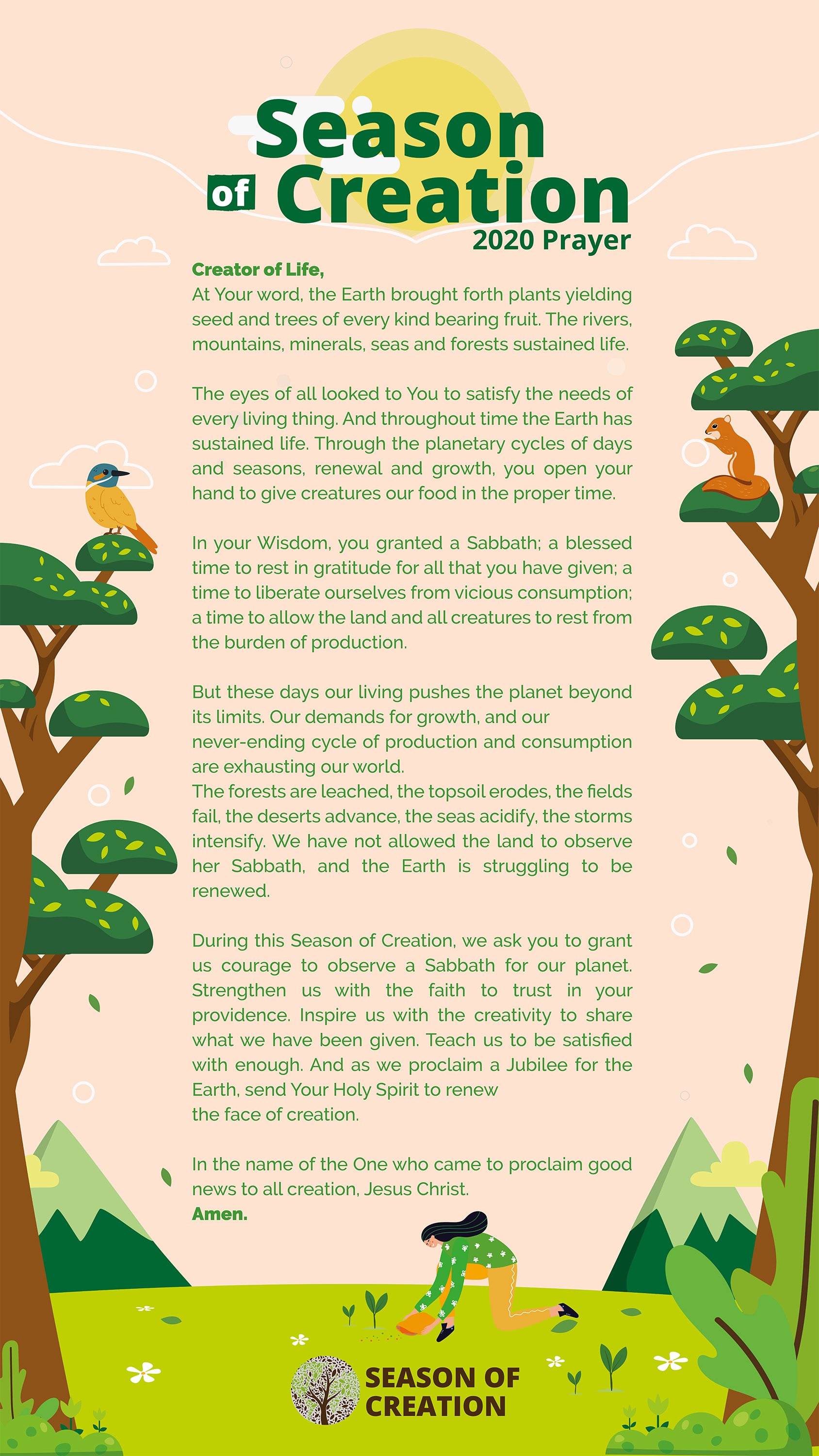
SEASON OF CREATION
On September 1 we entered into what is being called the Season of Creation, a month-long prayerful observance that calls the planet’s 2.2 billion Christians to pray and care for God’s creation. It’s a time to reflect on our relationship with the environment — not just “distant” nature, but, crucially, the place where we live — and the ways in which our lifestyles and decisions as a society can endanger both the natural world and those inhabiting it, both humans and other creatures.
The ecumenical steering committee that plans and promotes the season each year put it this way:
“The Season of Creation is a time to renew our relationship with our Creator and all creation through celebration, conversion, and commitment together. During the Season of Creation, we join our sisters and brothers in the ecumenical family in prayer and action for our common home. It’s a time of prayer, contemplation and, increasingly, calls to action.”
The Season of Creation is supported by a number of leading Christian organizations, including the World Council of Churches, Christian Aid, the Lutheran World Federation, the Anglican Communion Environmental Network, the Global Catholic Climate Movement and the Vatican’s Dicastery for the Promotion of Integral Human Development. Each sits on the Season of Creation steering committee.
The Season of Creation spans 34 days. It begins Sept. 1, the World Day of Prayer for the Care of Creation. It concludes Oct. 4, the feast of St. Francis of Assisi, the patron saint of ecology. As it happens, the season aligns with the fall harvest season — a time when the state of the Earth might be front of mind for many people.
Over time, the single day of prayer expanded to a full season, with the World Council of Churches playing a leading role. One of the first organized celebrations of the season was held in 2000 at a Lutheran church in Adelaide, Australia. In 2003, the Catholic Church in the Philippines began asking Catholics to observe Creation Time.
More recently, the Season of Creation has become a more ecumenical celebration among all Christians. And the past few years have seen it gain traction among Catholics. For that, you can point to Pope Francis.
Just months after publishing his 2015 encyclical “Laudato Si’, on Care for Our Common Home,” Pope Francis formally added the World Day of Prayer for the Care of Creation to the Catholic calendar as an annual day of prayer. And last year, he officially invited Catholics to celebrate the full season.
“Now is the time to rediscover our vocation as children of God, brothers and sisters, and stewards of creation. Now is the time to repent, to be converted and to return to our roots,” he wrote in a letter. “We are beloved creatures of God, who in His goodness calls us to love life and live it in communion with the rest of creation. For this reason, I strongly encourage the faithful to pray in these days that, as the result of a timely ecumenical initiative, these days are being celebrated as a Season of Creation.”
This year, organizers suggested the theme, “Jubilee for the Earth: New Rhythms, New Hope.” Jubilee, in biblical terms, refers to a period of restoration every 50 years, when the land rests and justice is restored. The theme is, in part, a nod to the 50th Celebration of Earth Day, which occurred in April. That the global coronavirus pandemic came as the planet nears climate tipping points shows how social, economic and ecological realities are interconnected, the Season of Creation steering committee said in explaining the theme.
“During the season this year, we enter a time of restoration and hope, a jubilee for our Earth, that requires radically new ways of living with creation,” the committee said, including “the need for just and sustainable systems” to take better care of both people and planet.
[There is a Season of Creation website for those who wish to learn more.]
 parishionersforjustice.com